
When we are young, we ask a lot of questions.
Why is the sky blue?
Why do I have to eat all my vegetables?
Why do I have a bedtime?
Why do we spend all day at school, only to come home and do more schoolwork?
That last one still nags at me.
As we grow older, our questions may change, but they rarely disappear. Something else changes instead.
We stop asking them.
We may still think about them. Sometimes we quietly type them into Google. Other times, we push them aside because they seem silly, uncomfortable, too complicated, or impossible to answer.
But why?
What causes us to stop asking questions?
It is not because we suddenly know everything. Some people may disagree, but I can honestly say I am seldom the smartest man in any room.
Maybe we become afraid of looking foolish. Maybe we worry that everyone else already knows the answer. Maybe adulthood simply fills our minds with so many practical concerns that curiosity gets pushed toward the back.
Whatever the reason, I think something important is lost when we stop asking questions.
Especially for writers.
What If?
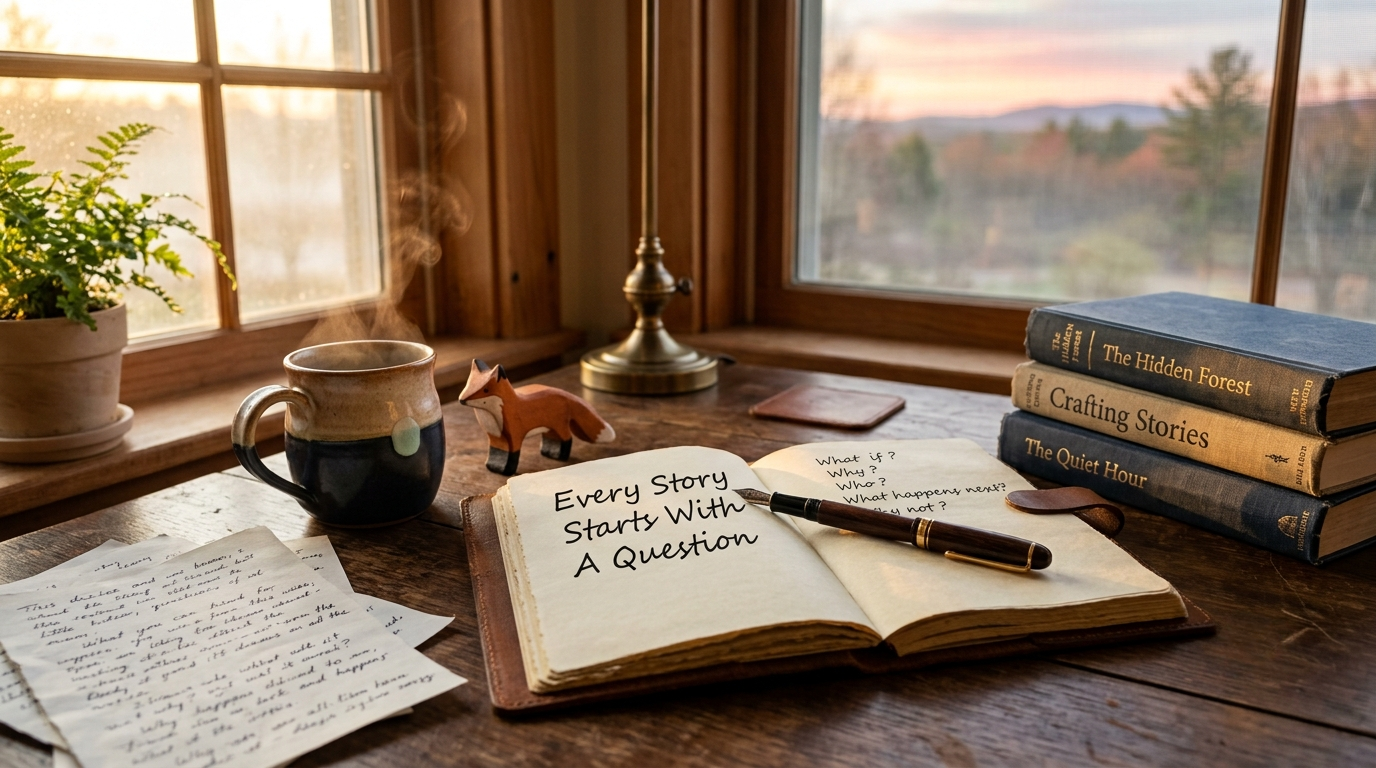
Every story starts with a question.
That may sound like a cliché, but for me, it is true. Most of my stories begin with a nagging question that refuses to leave me alone.
Usually, it begins with two simple words:
What if?
What if a little boy received a robot that was a completely blank slate?
What questions would the robot ask?
What would the boy try to teach it?
How would a child’s explanation of the world differ from an adult’s?
Those questions became the beginning of Rusty’s Big Questions.
Rusty is a robot who knows very little about people, families, feelings, or everyday life. His friend Robbie has to explain those things to him, but Robbie is still figuring them out himself.
Naturally, Rusty would have questions.
What is a mom?
What is a dad?
What is a friend?
What is sleep?
Each question creates the beginning of a story, but it also leads to more questions.
How does a child describe love?
How do you explain friendship to someone who has never had a friend?
How do you explain something as ordinary and mysterious as falling asleep?
The questions give me a way into the story. They help me find the characters, the humor, and eventually the emotional center.
Finding Stories in Strange Places
Some questions are a little less philosophical.
For example:
What kinds of things do people find gross or disgusting that could still become cute and lovable characters?
That question helped lead to Booger Saves the Day.
Yes, I wrote a story about a heroic booger.
No, I do not regret it.
A similar question helped inspire Hug Bug Doug.
What if a bug loved giving people hugs, but everyone kept running away because they thought he was attacking them?
The humor comes from the misunderstanding, but beneath it is another question:
What happens when someone has a lot of love to give, but people are too afraid to accept it?
That is one of the things I enjoy most about writing for children. A silly question can lead somewhere surprisingly meaningful.
A story can begin with a booger, a bug, a robot, or a stubborn little bird, and still find its way toward courage, love, friendship, confidence, or belonging.
Questions About Who We Are
Other stories begin with questions about emotion and personality.
What if a child desperately wanted to come out of his shell?
What if he knew what he wanted to say but could not make himself say it?
What might help him take that first small step?
Those questions helped shape Benny’s New Kicks, a story about a quiet little boy whose new shoes help him begin finding his voice.
The shoes are not magical. They do not suddenly turn Benny into someone else. They simply help him feel a little more confident.
That led to more questions.
What does bravery look like for a shy child?
Does bravery have to be loud?
Can raising your hand in class be an act of courage?
Can speaking one sentence feel like climbing a mountain?
Questions like those help me move beyond the surface of an idea. A story about new sneakers becomes a story about confidence, fear, and discovering that a small step can still be an important one.
Questions Grow Up Too
Most of those examples come from my children’s writing, but the questions continue when I work on adult fiction.
They simply become darker, stranger, and sometimes more uncomfortable.
Lately, I have been working on an adult fiction project called The Testimonies of Ashbury Asylum.
It is an anthology-style collection of connected stories about a detective and a doctor reviewing patient files from Ashbury Asylum. The facility is closing, and they must determine whether its patients can safely be transferred to less secure facilities.
The project began with questions.
What causes someone to be considered insane?
What happens when something impossible happens to an ordinary person, but no one believes their explanation?
Who gets to decide what is real?
What secrets might an institution hide behind locked doors?
What if some of the patients are not imagining what happened to them?
Each patient file opens the door to a new mystery, but the larger questions connect them.
Are the patients dangerous?
Are they victims?
Are they telling the truth?
And what happens when the people responsible for judging them begin to question their own understanding of reality?
That is often how my adult fiction develops. One question leads to another, and before long, I have characters, histories, institutions, conflicts, and an entire world growing around the original idea.
When Science Fiction Becomes Science
Another project I have been developing for a long time is the Heartless series.
That story grew out of questions about fringe science, technology, desperation, and the choices people make when they believe they have nothing left to lose.
What happens when fringe science becomes accepted science, or science fiction becomes simply science?
How far will people go to escape pain?
What will corporations, governments, or individuals justify if the technology exists?
Just because something can be done, does that mean it should be done?
Those questions do not always have easy answers, which is exactly why they interest me.
I am drawn to stories where technology places ordinary people in impossible situations. The science may create the problem, but the story is really about the human choices that follow.
That is where the most important questions usually live.
Who are we when our memories are taken from us?
What makes someone human?
How much of ourselves can we surrender before we stop being ourselves?
The Questions Become Real
Then there is my occasional dabbling in nonfiction.
Nonfiction pushes questions to another level because the answers have real-world consequences.
These are not questions about imaginary monsters hiding in closets.
They are questions about the real monsters whose choices shape the world, sometimes publicly and sometimes from the shadows.
How are people influenced without realizing it?
How do governments, corporations, organizations, and media outlets shape the way people think?
What happens when profit becomes more important than safety?
Who benefits when information is hidden?
What happens to people who speak up?
Why do large groups of people believe things that are demonstrably untrue?
In fiction, I can create a corrupt institution or a dangerous technology.
In nonfiction, the research sometimes reveals that reality has already created something more disturbing than I would have imagined.
That is part of what makes nonfiction uncomfortable for me.
The questions do not remain safely inside a fictional world. They lead to real people, real decisions, and real consequences.
But that also makes the questions worth asking.
Keep Asking
Questions are where stories begin.
They are also how stories grow.
A question creates the first spark. Another question builds the character. Another creates the conflict. Another reveals what the story is really about.
What if?
Why?
Why not?
What would happen next?
What would I do?
What would this character never do?
What might finally force them to do it?
Writers do not need to have all the answers when they begin.
Sometimes we only need a question interesting enough to follow.
So ask questions.
Ask lots of them.
Do not let embarrassment, adulthood, or the fear of sounding foolish stop you.
Write the questions down.
Keep a notebook nearby.
Think about them while you drive, walk, garden, work, or try to fall asleep.
Let one question lead to another.
You may not find an answer.
But you might find a character.
A world.
A mystery.
A story.
And that could be the beginning of something special.
Thanks for stopping by.
I’d love it if you came back again.