
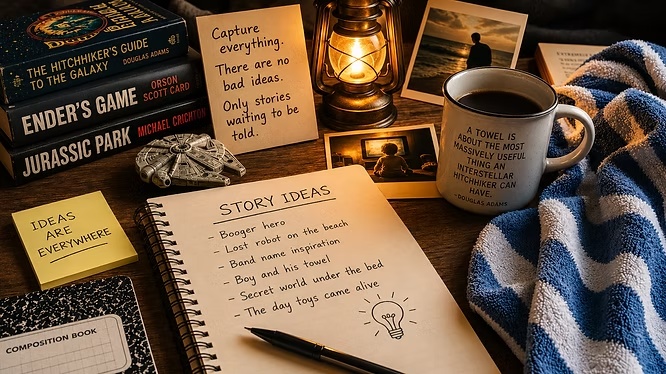
What helps drive my stories?
Inspiration can come from anywhere. And I really do mean anywhere.
For me, it is often the simplest things that trigger an idea. A lyric in a song. A scene in a movie or TV show. A sentence from a book. A name. A place. A memory. Sometimes even something completely ridiculous.
Recently, the name of a band triggered a story idea for me.
That is the funny thing about inspiration. It does not always arrive with fireworks. Sometimes it shows up as one tiny spark. And it can be very easy to have that moment and think, “Oh, I’ll remember that when the time comes to write it down.”
That does not work for me.
I need to write it down… Immediately!
Even if it is only a brief, fleeting idea, I try to capture it before it disappears. From there, I let it sit for a while. I think about it. I turn it over in my head. I let it grow. Eventually, I start building around it: the character, the problem, the solution, the world, and the story arc.
In many ways, probably because I grew up in the 80s with big blockbuster movies, I often start by imagining scenes. A chase. A fight. A funny moment. A quiet emotional beat. A sequence that could set the stage for something bigger or maybe become the moment people remember most.
Over the years, I have written down hundreds of ideas.
And I am not saying that to pat myself on the back, because I have probably forgotten twice as many. Those were the ideas I thought I would remember later.
Spoiler alert: I did not.
So now I try to capture everything.
There are no bad ideas at the beginning. Some ideas become full stories. Some become one scene. Some become a character. Some sit quietly in a notebook for years before they finally find their place. While some will never leave that notebook. But they are all full of potential.
That is why I think every writer needs a place to store ideas. It could be a notebook. It could be an app on your phone. It could be a running note, a voice memo, or a text message to yourself. The method does not matter nearly as much as the habit.
Recently, I was drifting off to sleep when I got an idea about a booger who becomes an accidental hero.
My first thought was, “It’s late. I’ll remember it in the morning.”
Thankfully, I manually overrode myself, grabbed my phone, and texted myself the idea. The next morning, I got to work. Within a few hours, I had fleshed out one of the grossest, and yes, funniest, children’s stories I have written so far.
At least, that is my opinion.
I know it has at least one fan, because it is the story my son asks for the most.
Another thing I like to do is keep a notebook with me in places where I am most likely to feel inspired. Of course, inspiration can strike at any time, so this is not an exact science. But I know certain places and situations tend to get my mind moving: the beach, vacations, reading a good book, watching a movie, or finding a story that makes me want to become a better writer.
Douglas Adams famously told us that a towel is “about the most massively useful thing an interstellar hitchhiker can have.”
For writers, I think a notebook, or at least some way to capture ideas, might fit that role.
You never know when you are going to need it.
Another helpful thing is surrounding yourself with stories that make you want to create. For me, that often means science fiction, big questions, uncomfortable situations, strange worlds, and characters I care about more than I expected to.
I love it when a story makes me feel deeply attached to a character. I love it when it surprises me by making me laugh, or think, or tear up over something I did not expect. That is good storytelling. When a story can make you care about a toy, a robot, a fox, a scarecrow, or even a booger, that is something special.
Family is another huge source of inspiration for me.
I often put bits and pieces of real life into my writing. Not always directly, and not always in obvious ways, but they are there. A place I remember. A funny thing my son said. A feeling from childhood. A family phrase. A situation that stuck with me.
Those real details can help make even the silliest story feel grounded.
I once heard that one reason Dan Brown’s books can feel so grounded is that he actually visits many of the places he writes about. That makes sense to me. When you write about a place you have been, or a feeling you have actually felt, there is a different kind of truth on the page.
That does not mean every story has to be based on real life. Far from it. Some of the best stories are wildly imaginative.
But even the wildest story needs something real inside it.
So, where do stories come from?
Everywhere.
A song. A movie. A book. A beach. A memory. A bedtime thought. A ridiculous idea that arrives just when you are trying to fall asleep.
The trick is learning to notice the spark when it shows up.
And then, before it floats away, write it down.
Thanks for stopping by.
I’d love it if you stopped by again.