I want to preface this Story Note by saying that while I’ll mostly be talking about children’s picture books, I think reading your story aloud can help with just about anything you write.
There are two ways to find out whether a picture book works.
You can read it silently to yourself, or you can read it aloud to a child and discover every place where your tongue files a formal complaint against the wording and the maniac who chose that sentence structure.
There’s a famous quote attributed to Harrison Ford, who reportedly criticized George Lucas’s dialogue while filming the original Star Wars. Ford is said to have remarked, “George, you can type this [NAUGHTY WORD], but you sure can’t say it! Move your mouth when you’re typing!”
As someone who writes children’s picture books, I’ve learned there’s a big difference between a story that looks good on paper and one that sounds good coming out of your mouth. Especially when that mouth belongs to a parent who has already read the same book seventeen times this week.
And it’s only Tuesday.
One of the things I love about picture books is how different they are from other kinds of storytelling. When I write fiction for adults, I know most readers will experience the story quietly, hearing the characters and dialogue in their own heads.
But picture books?
Picture books are begging to be performed.
There’s the dramatic pause before something unexpected happens. The ridiculous voice you give a character without realizing you’ve committed to doing it for the next twenty pages. The sound effects that somehow get louder every time you read the story.
And, of course, the child who notices immediately when you try to skip a page.
Nice try, Dad.
When I’m writing a picture book, I try to remember that I’m not just writing for the child listening. I’m also writing for the person reading. The words need to flow naturally. The dialogue needs to be fun to say. The humor needs to work when it’s spoken, not just when it’s sitting quietly on the page.
Sometimes that means reading a sentence aloud over and over until it finally sounds right. Other times it means realizing that a sentence I thought was clever is actually a verbal obstacle course, complete with traps at every corner.
And occasionally it means laughing at something I’ve written and wondering whether anyone else will find it nearly as funny as I do.
That’s always a possibility.
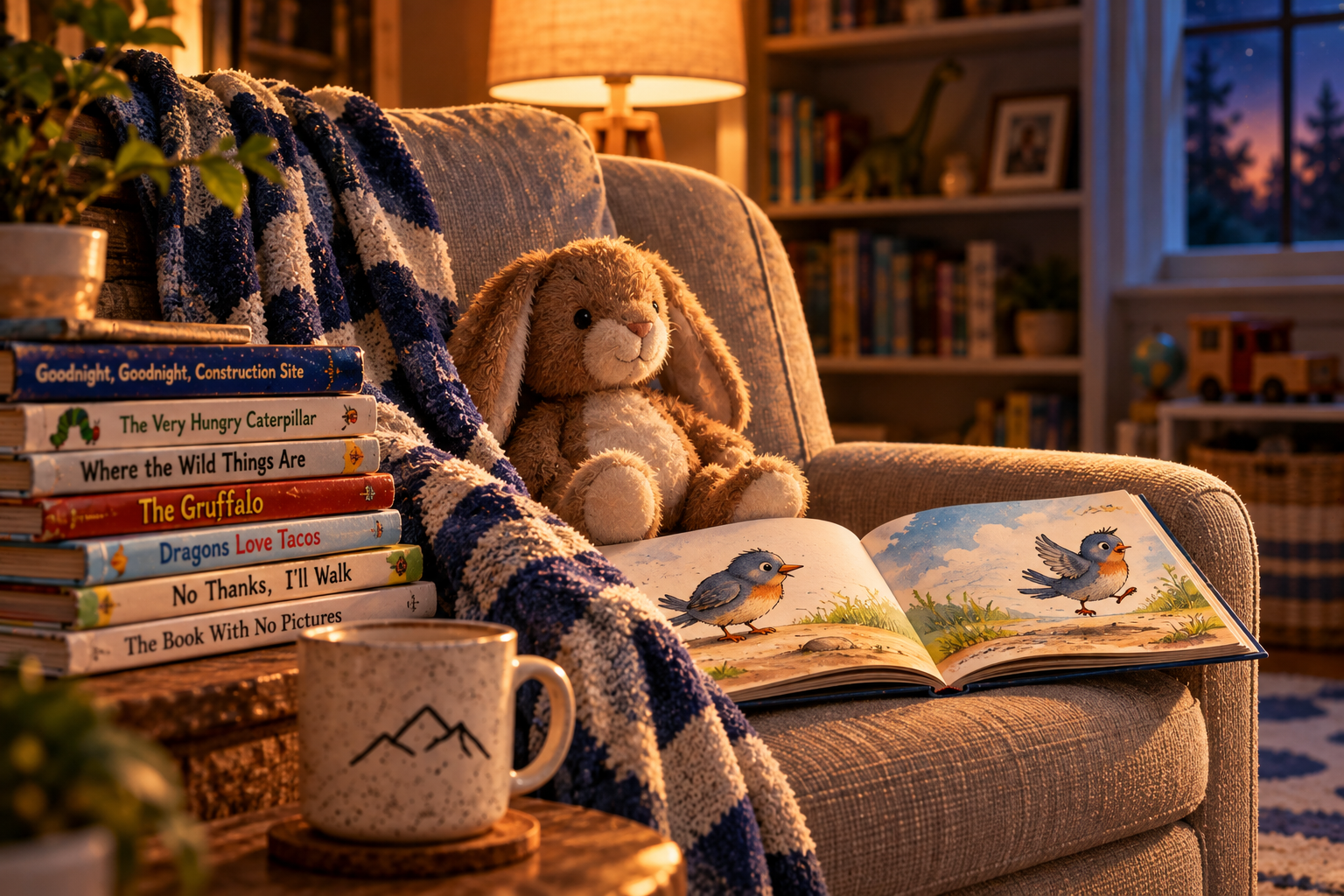
I learned this firsthand while working on one of my manuscripts, No Thanks, I’ll Walk. It follows a stubborn little bird who’s afraid to fly. Rather than face his fear, he decides flying is completely unnecessary.
After all, why fly when you have two perfectly good feet?
When I first wrote the story, I thought it was pretty good. I read it through on my own, enjoyed the humor, and felt like I had something that worked.
Then I read it to my son.
And, well, let’s just say he wasn’t as impressed as I was.
What seemed funny on paper wasn’t connecting with him the way I’d hoped. The story wasn’t landing.
It was a valuable lesson. I went back and made considerable changes, reworking parts I’d originally thought were just fine. To this day, No Thanks, I’ll Walk is still very much a work in progress.
But the experience reminded me of something important. As writers, we can get so close to our own stories that it’s hard to see what’s working and what isn’t. Reading aloud helps us hear the problems. Reading to someone else helps us find the ones we didn’t know were there.
And when that someone happens to be a child, they’re not particularly concerned with protecting your feelings.
Which, come to think of it, makes them excellent critics.
But there’s another part of reading aloud that I think matters even more.
It isn’t really just about the book. It’s about the person sitting beside you, or curled up against you, listening. It’s about the little voice asking what happens next, even though they’ve heard the story enough times to know exactly what happens next. It’s about the laughter that arrives before the punchline because they already know what’s coming.
And it’s about the request every parent eventually hears.
“Again!”
I think there’s something special about that.
As writers, we spend a lot of time thinking about our characters, our words, and the stories we’re trying to tell. But once a picture book finds its way into someone’s home, it becomes part of something bigger. A bedtime routine. A rainy afternoon. A quiet moment between a parent and child.
The story might belong to the writer, but the experience belongs to the people sharing it.
Maybe that’s what makes picture books so special. They aren’t simply stories meant to be read.
They’re stories meant to be shared.
So while I certainly hope the children who someday read my books will fall in love with the characters and their adventures, I have another hope, too. I hope the adults reading them have just as much fun bringing those stories to life.
Even on the seventeenth reading...
I mean, especially on the seventeenth reading.
Now I’m curious. Parents, grandparents, aunties, uncles, teachers, and fellow readers: is there a children’s book you’ve read so many times you practically know it by heart?
And for my fellow writers: have you ever read something aloud and realized it wasn’t working nearly as well as you thought?